

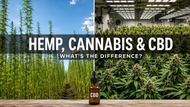
Hemp, Cannabis, and CBD: What's the Actual Difference?
Posted by Moongrass Miles on Aug 29th 2026
Hemp, Cannabis, and CBD: What's the Actual Difference?
If you've wandered a dispensary menu or a gas-station CBD display and walked away more confused than when you started, you're not alone. Hemp, cannabis, marijuana, CBD, THC, THCA — the vocabulary gets thrown around like everyone already knows what it means. Most of it comes down to one plant, a handful of compounds, and a legal line that's about to move. Here's the breakdown, from the botany to what actually happens when you consume it, to what these plants are doing outside the smoke shop entirely.
It's All One Plant
Here's the part that trips people up first: under U.S. law, hemp and marijuana aren't treated as separate species. Both are legally defined as Cannabis sativa L. Botanically it's a bit messier — some taxonomists recognize cannabis as one highly variable species, others split out additional species or subspecies — but there's no clean line dividing "hemp plants" from "marijuana plants" the way there is between, say, oak and maple. What centuries of selective breeding have produced are recognizable fiber, seed, and drug-type populations with different growth habits and typical cannabinoid profiles. The federal legal distinction, though, comes down almost entirely to chemistry.
Historically, the dividing line has been delta-9 THC (tetrahydrocannabinol) content. Under the 2018 Farm Bill, cannabis containing 0.3% or less delta-9 THC by dry weight qualified as hemp and was removed from the federal Controlled Substances Act. Anything above that threshold was marijuana, a Schedule I controlled substance federally, regardless of how it was actually being used. That said, the 2018 bill didn't make every hemp-derived product automatically legal for every purpose — cultivation still requires an approved hemp program, states can (and do) impose stricter rules, and the FDA retained authority over foods, supplements, and cosmetics.
That delta-9-only wording created a disputed opening in the market. USDA's crop-testing rules already account for THCA converting into delta-9 THC, but the statutory definition of hemp referenced delta-9 specifically — and post-harvest, finished products weren't regulated nearly as consistently as raw crops. Sellers leaned on that gap, plus a patchwork of state laws and enforcement, to market high-THCA flower and products built around delta-8 and other intoxicating cannabinoids. That's how "hemp-derived" gummies, drinks, and vapes with genuinely intoxicating effects ended up on shelves in states that hadn't otherwise legalized recreational cannabis.
A Big Regulatory Shift Is Coming
This is worth flagging for readers right now, because it's changing soon and it's more sweeping than most coverage suggests. On November 12, 2025, Congress enacted P.L. 119-37, which rewrites the federal hemp definition (7 U.S.C. § 1639o). It takes effect exactly a year later, on November 12, 2026, and it does two separate things:
- Replaces delta-9-only testing with a total THC standard. Hemp plant material now has to stay at or below 0.3% total THC by dry weight — a calculation that folds in THCA (converted at roughly a 0.877 ratio), delta-8, and other THC-class cannabinoids, not just delta-9.
- Caps finished products at 0.4 milligrams of total THC per container. This is the part that gets underplayed, and it's arguably the bigger deal for actual consumers: it's not a percentage test at all, and it's not per serving — it's the entire retail container. A lot of currently-legal full-spectrum gummies, seltzers, vapes, and tinctures contain several milligrams of total THC per package, well above that line.
Between those two provisions, most currently-marketed intoxicating "hemp-derived" products — THCA flower, delta-8 vapes, hemp beverages with real THC content — will fall outside the federal hemp definition once the rule takes effect, unless they're reformulated. Pure CBD isolate products, with no meaningful THC at all, are largely unaffected. The law also excludes cannabinoids that are synthesized or manufactured rather than naturally occurring in the plant.
The FDA was directed to publish official lists of naturally occurring cannabinoids and THC-class compounds within 90 days of enactment — that deadline (February 2026) has already passed as of this writing, and how those lists get applied will shape exactly what survives.
One more wrinkle, as of late August 2026: the November 12 date may not hold. On August 8, 2026, the Senate passed a continuing resolution, 90–6, that would push most of Section 781's restrictions back to December 11, 2026. It still needs House agreement to become law, so it isn't settled yet — and even if it passes, the delay isn't total. The exclusion for fully synthetic cannabinoids (things like HHC and THC-O, which aren't naturally produced by the plant) would still take effect on November 12 regardless. In other words: expect this timeline to keep moving through the fall, and expect genuine legal disputes once whichever deadline actually arrives, since a lot of retailers, manufacturers, and states have built compliance plans around a moving target.
CBD: The Non-Intoxicating One
CBD (cannabidiol) is a cannabinoid found in both hemp and marijuana plants, but it doesn't produce a high. It doesn't directly activate the brain's CB1 receptors the way delta-9 THC does — its pharmacology is more complex, involving indirect effects on the endocannabinoid system and several other biological targets — and that's the main reason it doesn't produce THC-like intoxication. "Non-intoxicating" is the more precise term than "non-psychoactive," since CBD is still biologically active and can affect things like anxiety or alertness.
For consumers, the practical distinctions look like this:
- CBD products (oils, tinctures, gummies, topicals) are typically derived from hemp and marketed for relaxation, sleep, or general wellness, generally without intoxication.
- THC products are what produce the classic cannabis high — euphoria, altered perception, appetite changes — and their legality depends entirely on THC concentration and where you live.
- "Full-spectrum" vs. "isolate" products differ in whether they include the plant's other cannabinoids and terpenes alongside CBD, which some consumers believe produces a more rounded effect (the "entourage effect"), though the science is still developing. Worth knowing: full-spectrum products can legally contain some THC, and depending on dose and individual sensitivity, that can occasionally produce noticeable effects or even a positive drug test — "full-spectrum" isn't a guarantee of zero THC.
Non-intoxicating doesn't mean risk-free, either. CBD can interact with certain medications, and nonprescription products vary a fair amount in purity and in whether the label matches what's actually in the bottle.
THC and the Smokable Side
For people who smoke cannabis recreationally or medically, THC dose is a major driver of effect — but the percentage on the label doesn't fully predict the experience on its own. Serving size, route of administration (smoking hits differently than an edible), tolerance, how much CBD is in the mix, and individual physiology all matter too. Flower, pre-rolls, and concentrates from state-licensed marijuana dispensaries are typically bred and processed for higher THC content, often marketed with sativa-leaning "energizing" or indica-leaning "relaxing" labels — though those labels frequently don't map cleanly onto genetics or reliably predict effects, so treat them as rough marketing shorthand rather than pharmacology.
The rise of THCA flower is worth a mention here too, since it's become one of the more confusing corners of the market. THCA isn't intoxicating in its raw form, but heating it (smoking or vaping) causes decarboxylation, converting a portion of it into delta-9 THC — which is why high-THCA flower produces ordinary cannabis intoxication once it's lit. That's exactly the kind of product the incoming total-THC standard and the 0.4 mg/container cap are aimed at closing off.
Beyond the Smoke: Industrial and Practical Uses
It's easy to forget, in a conversation dominated by CBD gummies and vape carts, that hemp has centuries of history as a working crop with nothing to do with getting high — used for rope, sails, and fabric well before the modern cannabinoid market existed. Today, that industrial side is still very real:
- Textiles and fiber — hemp fiber is durable and biodegradable, used in fabric, rope, and increasingly in blended clothing lines marketed as sustainable alternatives to cotton.
- Hempcrete and building materials — a mix of hemp hurd (the woody core of the stalk) and lime, used as an insulating construction material. It can have a comparatively small carbon footprint, though how "low-carbon" it actually nets out depends on farming practices, lime production, and transport — it's not automatically carbon-neutral just by being hemp.
- Paper — hemp pulp is an alternative to wood pulp, though it hasn't scaled to compete with traditional paper manufacturing.
- Hemp seed oil and food — hemp seeds don't naturally contain meaningful cannabinoids (though trace contamination from nearby flower material is possible during harvest), and the oil pressed from them is sold as a nutritional product rich in omega fatty acids, distinct entirely from CBD or THC products.
- Bioplastics — hemp-derived materials are used in some biodegradable plastic composites, though this remains a small niche compared to petroleum-based plastics.
These industrial uses come from hemp varietals bred for fiber and seed yield rather than cannabinoid content, which is part of why hemp's status as an agricultural crop and its status as a source of consumable cannabinoids get regulated somewhat separately even under the same underlying law.
The Short Version
- Cannabis is the plant genus that includes both hemp and marijuana; under U.S. law they aren't separate species, though cannabis taxonomy itself is still debated among botanists.
- Hemp is a legal category built mainly around cannabinoid content, not a cleanly separate plant.
- Marijuana is the federal term for cannabis that falls outside the hemp definition — still a Schedule I controlled substance federally, regardless of state law.
- CBD is a non-intoxicating (not risk-free) cannabinoid found in both; THC is the intoxicating one, though dose, delivery method, and individual physiology all shape the actual experience, not the percentage alone.
- Industrially, hemp's fiber, seed, and hurd have uses that have nothing to do with cannabinoids at all.
- Watch November 12, 2026 — the federal hemp definition shifts to a total-THC standard for plant material and adds a 0.4 mg-per-container cap on THC in finished products, which is expected to push most currently-intoxicating "hemp-derived" gummies, drinks, vapes, and flower out of the federal hemp category unless reformulated.
This article is for general informational purposes and isn't legal advice — cannabis and hemp law varies significantly by state and is actively changing at the federal level.
Sources
- Congressional Research Service, Change to Federal Definition of Hemp and Implications for Federal Enforcement, Congress.gov
- Congressional Research Service, Changes to the Federal Definition of Hemp: Legal Considerations Under the Controlled Substances Act, Congress.gov
- Congressional Research Service, Changes to the Statutory Definition of Hemp and Implications for Agricultural Policy, Congress.gov
- Frier Levitt, The Redefinition of "Hemp" Under Federal Law: Regulatory Status, Legislative Developments, and Pending Industry Challenges
- DLA Piper, New Federal Restrictions on Hemp and Hemp-Derived Products: Top Points
- CADCA, Senate Votes to Delay Hemp Restrictions
- High Times, Hemp Ban Delay: What the Senate's December 11 Proposal Actually Covers
- Nothing But Canna, Senate Funding Bill Includes Temporary Extension for Hemp
- Legislative Analysis and Public Policy Association, Closing the Hemp Loophole fact sheet