

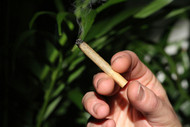
Mindful Puffing: The Art of Controlled, Balanced, and Functional Consumption
Posted by MoonGrass on Sep 17th 2026
Why Today’s Smoke Sessions Feel So Different
Walk into any traditional dispensary these days and you’ll spot it right away: a race to see who can pack the most punch. THC percentages are plastered on labels like they’re bragging rights, and every product seems engineered to go right up to the edge. Instead of a mellow, enjoyable night, you might find yourself wondering if you accidentally signed up for flight school. For many fans (especially those who care about wellness), just one hit of a super-strong Delta-9 flower can bring on mental fog, couch lock, or that familiar, jittery anxiety that just won’t leave.
But what if you genuinely love the ritual? The rolling, the deep earthy smell of real terpenes, the satisfying flick of the lighter, and that slow first exhale when you finally feel your shoulders drop. What if you want all the good parts—without losing your whole evening to the ceiling?
Turns out, you’re definitely not alone. The market is finally catching on, offering a quiet shift toward mindful consumption and smarter, more balanced cannabinoid choices.
Why Delta-8 Offers a Genuinely Different Middle Ground
If Delta-9 THC is the espresso shot of cannabinoids, Delta-8 THC is more like a well-made latte — related, familiar, but a noticeably gentler ride. And this isn’t just marketing poetry. It’s backed by actual pharmacology.
Delta-8 and Delta-9 are isomers — molecular siblings with the exact same chemical formula, differing only in where a single double bond sits along the carbon chain. That one small structural shift changes how tightly each molecule binds to your brain’s CB1 receptors. Delta-9 locks in hard. Delta-8 binds more loosely, and because delta-8 activates CB1 receptors less strongly than delta-9, its intoxicating effects tend to be milder. Historical inhalation studies estimate delta-8 may be roughly half as potent as delta-9, a finding that lines up with a landmark 2024 clinical trial.
That trial is worth dwelling on for a second, because it’s rare for a cannabinoid trend to actually get studied properly before millions of people are already using it. Researchers affiliated with Johns Hopkins ran the first human study in over five decades to look at Delta-8 THC’s effects, giving 19 adults edibles dosed with either Delta-8, Delta-9, or a placebo. Their conclusion: Delta-8 produced dose-dependent effects that were qualitatively similar to Delta-9 but consistently lower in potency at equivalent doses — though cranking the Delta-8 dose up high enough could close that gap.
In plainer English: Delta-8 isn’t a different drug wearing a costume. It’s the same general experience, turned down a few notches, which is exactly why so many people describe it as a “centered, daytime-friendly buzz” or a gateway to mild euphoria and physical relaxation rather than a full cognitive shutdown. It’s a solid option for creative work, a busy afternoon, or a wind-down that doesn’t write off the rest of your evening.
One honest caveat, because mindful consumption should mean mindful information too: Delta-8 sits in a genuinely messy legal gray zone. The 2018 Farm Bill legalized hemp and its derivatives, and Delta-8 is typically converted from hemp-derived CBD — but the 2018 Farm Bill is widely considered to have removed the THC isomer from the federal list of controlled substances, and hemp companies quickly found a commercial use for their excess CBD isolate. The DEA disagrees with that reading; in 2020 it issued an interim final rule declaring that all synthetically derived THC remains a Schedule I controlled substance, and Delta-8, because it’s manufactured from hemp-derived CBD rather than extracted directly from the plant, falls under that definition according to the agency. Meanwhile, states have gone their own way — it’s legally available with limited regulation in roughly 22 states and D.C., while others have restricted or banned it outright. Translation: know your state’s rules before you buy, and buy from brands that third-party test.
The Power of the 1.25g and 1.5g Pre-Roll for Microdosing
Building a mindful smoking habit is as much about format as it is about the compound itself. Handing someone a giant, heavily concentrated pre-roll and telling them to “find their sweet spot” is like handing someone a fire hose and asking them to water a houseplant.
This is where precisely measured pre-rolls actually earn their keep. A 1.25-gram organic herbal pack or a terpene-infused 1.5-gram single tube gives you a known quantity to work with instead of a mystery brick.
The Single-Puff Strategy. Microdosing doesn’t mean finishing the whole joint in one sitting — that’s kind of the entire point of the strategy. One or two slow, intentional draws let the cannabinoids ease in gradually rather than arriving all at once like an uninvited houseguest.
The Clean Extinguish. Snuff it out, slide it back into its airtight travel tube, and pick it up later exactly where you left off. Think of it less like a cigarette and more like a fine espresso — something meant to be sipped and measured, not inhaled in a rush.
A quick reality check worth building into any microdosing plan: individual tolerance varies a lot, and “low and slow” beats “start big and hope.” If you’re newer to cannabinoids, or trying a product from a brand you haven’t used before, the first session is a good time to underestimate rather than overestimate.
Layering the Experience with Botanical Synergies (and Being Honest About THC-P)
Mindful consumption isn’t only about using less — it’s about being more deliberate with what you do use. Pairing clean cannabinoids with premium, non-cannabis botanicals like Mullein, Damiana, or a dusting of CBG kief is where things get genuinely interesting from a formulation standpoint. Mullein and Damiana lend flavor and a calming ritual quality to the smoke, while the cannabinoid does the heavier lifting on mood and body sensation.
This layered approach draws on the “entourage effect” — the idea that cannabis compounds work better in combination than any single compound does alone. It’s a real and actively researched hypothesis: a 2021 University of Arizona study found that cannabis terpenes mimic cannabinoids and produce pain-relieving effects on their own, and that those effects are amplified without added side effects when terpenes are combined with cannabinoids. That said, the science is still developing rather than settled — a 2024 comprehensive review concluded that while exploratory research suggests terpenes influence the therapeutic benefits of cannabinoids, the potential for synergistic enhancement remains unproven, and further clinical trials are needed. So: promising, credible, but not yet a closed case — which is honestly the right way to talk about most cannabis science right now.
Now, the part worth correcting rather than glossing over: not every alternative cannabinoid belongs in the “gentle and functional” conversation, and THC-P is the clearest example. Where Delta-8 is the milder sibling of Delta-9, THC-P is closer to Delta-9’s much more intense cousin. THC-P has a longer molecular side chain than Delta-9, and lab research found it binds to CB1 receptors up to 33 times more strongly than Delta-9, which researchers believe explains its notably more intense psychoactive potential. It’s also a newer, far less-studied compound — it hasn’t yet been studied in humans, only on human cells. None of that makes it off-limits, but it does mean a THC-P pre-roll deserves more caution and a smaller first puff, not the same casual approach you’d take with Delta-8 — regardless of how “smooth” the terpene blend around it tastes.
The Actual Point
Stepping away from the high-potency arms race isn’t about smoking less because you have to. It’s about smoking better because you want to stay a person who can hold a conversation, finish a thought, and remember why you walked into the kitchen. A measured pre-roll, an honest understanding of what’s actually in it, and a slower, more intentional session get you there — the ancient, peaceful ritual of smoking, on terms that actually work for a Tuesday afternoon.
Sources
- Vandrey, R., et al. (2024). Dose effects of oral and vaporized delta-8-THC and comparison to delta-9-THC in healthy adults. Drug and Alcohol Dependence, 260.
- Cannabis Science and Technology (April 2025). Clinical Trial Finds Delta-8 THC Holds Similar but Milder Effects than Delta-9 THC.
- Leafly. Science of Delta-8-THC vs. Delta-9-THC: Chemistry, Effects, Potency & Production.
- Riverfront Times (Sept 2024). Is THCP Stronger Than Delta 9? Sort of. What We Know So Far.
- The Bluntness. THC-P Guide: Is It the Strongest Type of THC?
- University of Arizona Health Sciences (July 2021). Study Shows Cannabis Terpenes Provide Pain Relief, Contribute to ‘Entourage Effect’.
- Pharmaceuticals (2024). The entourage effect in Cannabis Medicinal products: a comprehensive review.
- Hemp Industry Daily. More states banning delta-8 THC as regulators clarify its legality under federal law.
- National Cannabis Industry Association / CBD Oracle. Where Is Delta-8 THC Legal and Where Is It Banned?
This article is for informational purposes only and is not medical advice. Cannabinoid products, including hemp-derived Delta-8 and THC-P, are regulated differently by state, and legal status should be confirmed locally before purchase. Individual responses to cannabinoids vary; start with a low dose, especially with products you haven’t tried before.
xact terms.