

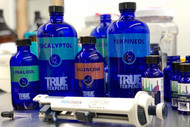
Sativa vs. Indica: How Terpenes Shape Your Herbal Smoking Experience
Posted by MoonGrass on Aug 20th 2026
Demystifying the Language of Smoking Rituals
If you've spent any time around modern smoking blends, you've run into the words Sativa and Indica. They started as botanical classifications for cannabis plants, but these days people use them more like a mood forecast — Sativa for energized and social, Indica for slow and grounded.
So what happens when a blend isn't cannabis at all, but a base of botanicals like Mullein or Damiana? Can a non-cannabis herbal smoke actually earn a "Sativa" or "Indica" label? The honest answer is more interesting — and more complicated — than the marketing usually lets on. It comes down to terpenes, but not in the clean, one-to-one way you'll often hear.
What Terpenes Actually Are
Terpenes are aromatic compounds found throughout the plant kingdom. They're why pine smells like pine, why citrus peel smells bright, why lavender smells calming. That part isn't in dispute — it's basic botany.
What's more actively researched is what terpenes do to your body and brain beyond scent. There's real, peer-reviewed evidence that terpenes aren't just along for the ride aromatically. A 2021 University of Arizona study found that several cannabis-associated terpenes — including linalool and beta-pinene — produced measurable behavioral effects in mice and could enhance the activity of cannabinoids when combined with them, suggesting terpenes have a pharmacological effect of their own, not just a scent profile.<sup>[1]</sup>
But — and this matters — the same body of research shows terpenes are not a simple substitute for cannabinoids. In one rat study on pain, isolated terpenes on their own didn't produce the pain-relieving effect; that came almost entirely from THC, with terpenes only adding benefit in combination with it.<sup>[2]</sup> And a clinical trial protocol reviewing this whole field noted plainly that there is currently no published human research directly testing how THC and terpenes interact — much of what circulates about specific terpene "effects" is still anecdotal rather than clinically confirmed.<sup>[3]</sup>
Translation: terpenes are pharmacologically active and worth taking seriously. But the idea that a specific terpene blend can reliably manufacture a specific, predictable experience is still a hypothesis being tested — not settled science.
The Sativa/Indica Split: What the Research Actually Says
Here's the part most blends don't tell you: the Sativa/Indica framework itself has taken a beating in the scientific literature over the past several years.
A 2022 analysis of roughly 90,000 commercial cannabis samples across six U.S. states found that Sativa, Indica, and hybrid labels were unreliable predictors of a product's actual chemical makeup or effects.<sup>[4]</sup> A separate genetic study of 297 strains found no meaningful genetic distinction between plants labeled Sativa versus Indica.<sup>[5]</sup> Dr. Ethan Russo, one of the most cited researchers in cannabinoid science, has been blunt about it, calling the lay Sativa/Indica distinction "total nonsense and an exercise in futility."<sup>[6]</sup>
What the research does support is that terpene and cannabinoid profiles — the actual chemistry — matter more than the Sativa/Indica label ever did. Myrcene tends to show up more in classically "Indica" profiles and is associated with sedating effects; limonene shows up more in "Sativa" profiles and is associated with uplift. But researchers are careful to note this isn't a hard rule — a myrcene-heavy product labeled "Sativa" can still land as sedating, and exceptions are common.<sup>[7]</sup>
So the more accurate framing isn't "this blend is Sativa, therefore energizing." It's closer to: "this blend is built around terpenes commonly associated with the alert, uplifted feeling people tend to describe as Sativa-like." Small wording shift, but it's the difference between a claim the data supports and one it doesn't.
Daytime-Leaning Profiles: Limonene and Pinene
Blends built around limonene (found in citrus) and pinene (found in pine needles) lean toward the brighter, more alert end of the spectrum people associate with daytime use. Moongrass's Pineapple Express and Uplift Sativa-profile pre-rolls are formulated around this terpene direction — worth trying if you're curious how a citrus-and-pine-forward terpene profile actually feels for you, since individual response varies more than strain names suggest.
Evening-Leaning Profiles: Myrcene and Linalool
On the other end, myrcene (also found in mangoes and hops) and linalool (the primary calming compound in lavender) are the terpenes most associated with the relaxed, wind-down feeling people describe as Indica-like. Moongrass's Purple Punch and Relax loose-leaf blend are built around this profile.
One thing worth flagging directly: several Moongrass blends, including the ones above, contain Delta-8 THC or THC-P — both of which are cannabinoids, not just herbal terpene infusions. That's a meaningfully different thing from a purely botanical, non-cannabinoid smoke, and it's worth knowing going in, both because cannabinoids carry their own effects independent of terpenes and because Delta-8 and THC-P's legal status varies by state. If you're choosing a blend specifically because you want to avoid cannabinoids, check the product page for cannabinoid content before buying — not every blend in a given "profile" family is formulated the same way.
Where That Leaves You
Terpene science is genuinely promising, and it's a more defensible way to think about smoking blends than the old Sativa/Indica shorthand. But it's still an evolving field — the entourage effect (the idea that terpenes and cannabinoids work better together than either does alone) is an active area of research, not a proven mechanism with a fixed formula.<sup>[1][2]</sup> If you're exploring blends like Moongrass's Runtz or any of the Sativa/Indica-leaning profiles above, the most useful approach is treating the labels as a rough starting hypothesis about feel, not a scientific guarantee — and paying attention to how your own body actually responds.
Sources
- LaVigne, J.E., Hecksel, R., Keresztes, A., & Streicher, J.M. (2021). Cannabis sativa terpenes are cannabimimetic and selectively enhance cannabinoid activity. Scientific Reports. https://www.ncbi.nlm.nih.gov/pmc/articles/PMC8050080/
- Harris, H.M., Rousseau, M.A., Wanas, A.S., et al. (2019). Role of Cannabinoids and Terpenes in Cannabis-Mediated Analgesia in Rats. Cannabis and Cannabinoid Research. https://pmc.ncbi.nlm.nih.gov/articles/PMC6757239
- ClinicalTrials.gov Protocol. Behavioral Pharmacology of THC and Alpha-pinene. https://cdn.clinicaltrials.gov/large-docs/33/NCT04130633/Prot_SAP_000.pdf
- Abstrax Tech. Do Terpenes Determine Indica or Sativa? https://abstraxtech.com/blogs/learn/do-terpenes-determine-indica-or-sativa
- Bedrocan / international genetic research summary. No Genetic Distinction Between Sativa and Indica Cannabis. https://bedrocan.com/international-research-shows-no-genetic-distinction-between-sativa-and-indica-cannabis/
- This Is Why I'm High. Indica vs Sativa: Why These Labels Don't Predict Your High. https://thisiswhyimhigh.com/learn/indica-vs-sativa-myth
- Kana Post. Indica vs Sativa Myths Debunked: What Modern Science Actually Reveals About Cannabis Strains. https://kanapost.co/indica-vs-sativa-myths-debunked-what-modern-science-actually-reveals-about-cannabis-strains/